
Thermal Management in Outdoor Electrical Cabinets: A Practical Guide for Engineers
Many engineers focus their energy on electrical wiring and structural integrity when designing outdoor cabinets, often treating thermal management as an afterthought. Usually, cooling isn't addressed until an overheating alarm triggers a panic.
However, if you ignore the thermal issues, the lifespan of expensive components—whether a Siemens PLC or an ABB VFD—will be drastically reduced. Outdoor electrical cabinets face a double threat: internal heat generation from heavy hitters like switching power supplies, Variable Frequency Drives (VFDs), and inverters, combined with external solar radiation.
On a summer afternoon, the surface temperature of a typical black metal cabinet can easily exceed 60°C (140°F). If the internal heat cannot escape, your cabinet effectively becomes a convection oven. Let’s skip the theoretical fluff and look at electrical cabinet cooling from a practical, design-centric perspective.
Why Electrical Cabinet Cooling Matters for Outdoor Industrial Equipment
This isn't about the cliché of "extending equipment life"; it is about preventing catastrophic failure.
VFDs and servo drives are incredibly temperature-sensitive. As a rule of thumb, for every 10°C rise in ambient temperature, the life of electronic components (especially electrolytic capacitors) is cut in half. For outdoor industrial equipment, the cost of downtime is often calculated by the minute.
A common issue in the field is the "brute force" approach: an engineer feels heat, so they install a larger industrial fan. The result? The temperature doesn't drop, but the cabinet fills with dust. The core of heat dissipation isn't just "air volume"—it is the "airflow path." If the air short-circuits inside the cabinet, or if the fan selection ignores the static pressure loss from filters, a nominal 500 CFM fan might not even deliver 100 CFM of actual cooling.

One Diagram to Understand Electrical Cabinet Ventilation Principles
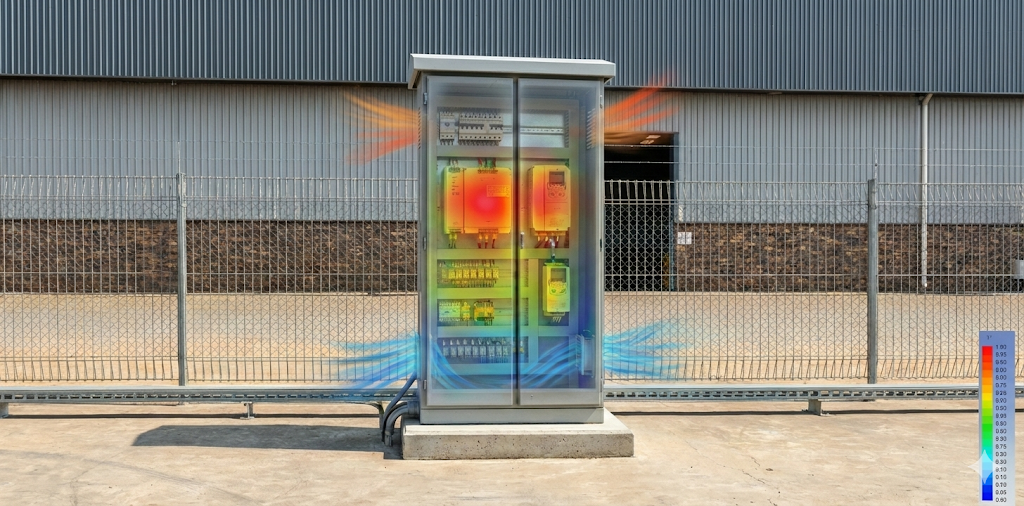
To understand electrical cabinet ventilation, you only need to remember one principle from high school physics: Hot air rises, cold air sinks.
When designing cabinet ventilation, whether using forced air or natural convection, never fight against thermal buoyancy. Follow this logic:
-
Intake: Must be located in the lower section of the cabinet (usually the bottom 1/3). This draws in the coolest air available in the environment.
-
Exhaust: Must be located in the upper section. Heat naturally travels upward; the cabinet fan simply accelerates this process to expel it.
-
Flow Path: Cold air enters, sweeps across the heat sinks of VFDs and power supplies, absorbs thermal energy, becomes hot air, and is ejected by the top fan.
The Worst Design: Placing the intake and exhaust at the same height, or both in the top half. This causes an immediate pneumatic "short circuit"—fresh air enters and exits immediately without ever cooling the equipment at the bottom.
How Axial Fans Manufacturers Design High-Efficiency Cabinet Airflow
Why do most systems utilize an axial fan rather than a centrifugal blower?
In the context of electrical cabinets, the priority is High Airflow to displace air volume, rather than extremely high static pressure. As long as the filters are not clogged, axial fans offer the highest efficiency.
As axial fans manufacturers, we focus heavily on the mid-range performance of the P-Q curve (Pressure-Airflow curve) during design.
-
Standard Logic (Negative Pressure): We generally recommend the "Bottom Intake, Top Exhaust" configuration. A fan at the top pulls air out (negative pressure), drawing fresh air through a filter at the bottom.
-
Positive Pressure (Pressurization): In specific scenarios, such as environments with heavy dust, we recommend a positive pressure design. Here, the fan is installed at the bottom blowing in, and the exhaust is at the top. This keeps the internal pressure slightly higher than the outside, preventing dust from entering through door gaps.
Critical Note: Once you add a dust filter, system impedance spikes. If you select a fan based solely on its "free air" rating, the actual airflow after installing a filter may drop by 40% or more. Engineering designs must account for this margin.
DC Axial Fan Manufacturer Perspective: When Is DC the Better Choice?
Historically, engineers defaulted to AC fans—plug them into the mains, and they spin. Simple. However, modern precision outdoor electrical cabinets are increasingly shifting toward DC technology.
From the perspective of a dc axial fan manufacturer, this shift is driven by two factors: energy efficiency and controllability.
-
Temperature Control & Speed Regulation: Outdoor temperature variance is extreme. At -20°C in winter, running a fan at full speed wastes power and risks internal condensation. At 40°C in summer, you need 100% power. DC fans paired with PWM (Pulse Width Modulation) can automatically adjust speed based on sensor readings. For off-grid equipment powered by solar or batteries, the energy savings are significant.
-
Wide Voltage Input: Voltage fluctuation is common in industrial settings. When AC voltage is unstable, fan speed drops, or coils can burn out. High-quality DC fans usually feature a wide voltage input range, ensuring stable operation despite fluctuations.
If your equipment sits in a climate-controlled server room with easy power access, AC fans remain the most cost-effective and reliable choice. But for the outdoors, DC is often superior.
Designing an Outdoor Electrical Cabinet Ventilation System Step by Step
Do not rely on guesswork. Follow this procedure:
-
Heat Load Calculation: Sum the heat dissipation of all components. Do not use the rated power; use the heat loss (e.g., VFDs typically dissipate 3-5% of their rated power as heat).
-
Determine Target Temperature Rise ($\Delta T$): How much hotter can the inside of the cabinet be compared to the outside? Typically, engineers aim for 5K or 10K ($5^\circ C$ or $10^\circ C$). The larger the allowable difference, the less airflow you need.
-
Apply the Formula:
$$V = \frac{3.1 \times P_{\text{loss}}}{\Delta T}$$Where $V$ is Airflow ($m^3/h$) and $P_{\text{loss}}$ is Total Heat Loss (W).
Note: This is a theoretical value. In practice, multiply the result by a coefficient of 1.2 to 1.5 to account for filter resistance and altitude.
-
Layout: Arrange intake and exhaust diagonally to create the longest possible airflow path, ensuring maximum coverage.
-
Protection Rating: Outdoor electrical cabinets require at least IP54 or IP55 protection. Always use rain hoods and ensure filters are made of non-woven fiber material that breathes while blocking water mist.
Common Ventilation Design Mistakes in Outdoor Electrical Cabinets
We see these errors in the field constantly. Use this list to audit your designs:
-
Fans Installed Backwards: Don't laugh; it happens. Instead of exhausting hot air, the fan forces it down, causing heat to accumulate at the top of the cabinet.
-
Neglecting Filter Maintenance: Designing without considering ease of filter replacement leads to failure. Within six months, filters clog, airflow hits zero, and equipment overheats. In harsh environments, consider clog-resistant metal filters or centrifugal separation designs.
-
Intake and Exhaust Too Close: The hot air just exhausted gets sucked right back into the intake. This often happens when multiple cabinets are installed side-by-side.
-
Ignoring Solar Radiation: If an outdoor cabinet is single-walled (sheet metal only), direct sunlight can overwhelm the fans. A double-walled design with insulation drastically improves natural cooling. Sometimes, a fan isn't enough, and you may need an air conditioner or heat exchanger.
Engineering is about trade-offs. No single axial fan delivers massive airflow, high pressure, and silence at a cheap price. When designing outdoor electrical cabinets, it is better to leave a generous margin for cooling rather than sending a technician to drill holes in the cabinet door on a scorching day because the equipment shut down.