
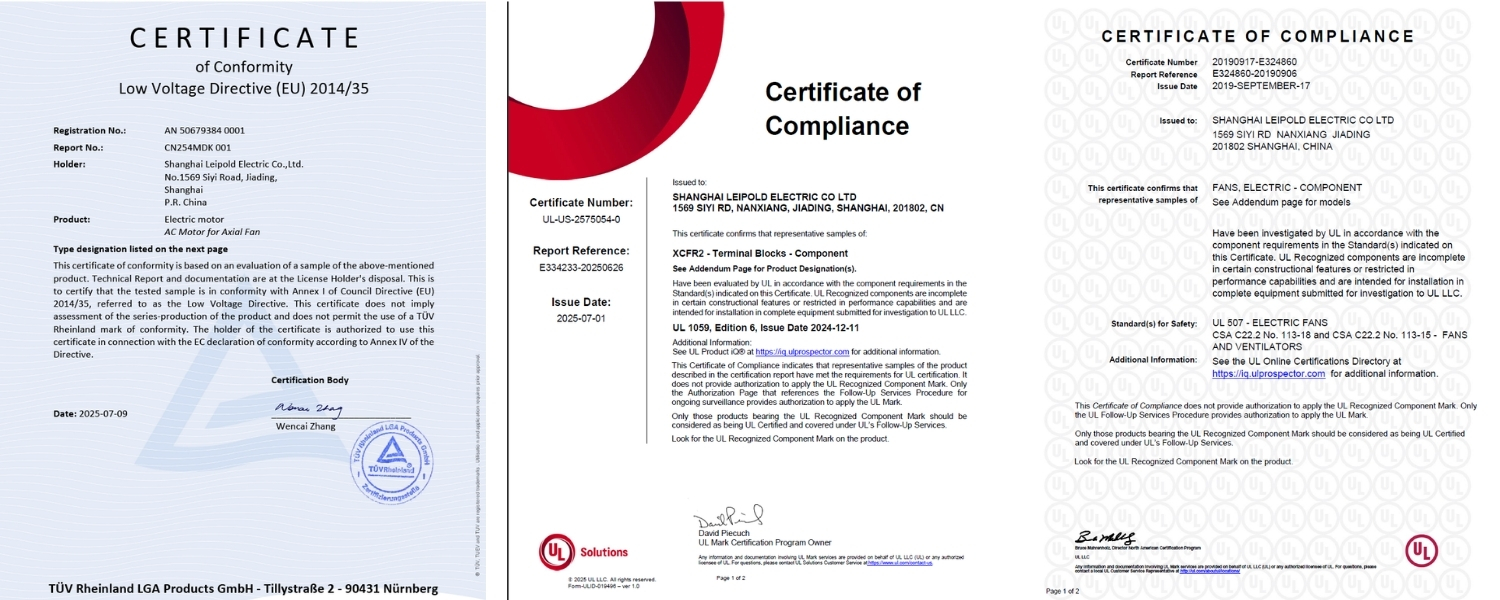
Integrating thermal management and electrical accessories into a control panel enclosure or industrial control panel enclosure requires more than matching physical dimensions and airflow ratings. For electrical engineers, panel builders, and industrial OEMs, component compliance dictates whether an entire machine or control system passes inspection, enters international markets, and operates safely throughout its lifecycle.
Navigating compliance markings can be complex. CE, UL, and RoHS are frequently referenced together on technical datasheets, yet they represent fundamentally distinct regulatory frameworks, testing scopes, and legal obligations. Confusing a safety standard with an environmental directive or assuming a CE mark guarantees North American acceptance can lead to rejected equipment, delayed commissioning, and costly field retrofits.
This guide details the operational and regulatory distinctions among CE, UL, and RoHS, explains their practical implications for enclosure components, and provides a structured protocol for verifying supplier compliance claims.
1. Demystifying CE, UL, and RoHS: Core Differences
To ensure seamless compliance for an industrial control panel enclosure, engineering and procurement teams must evaluate CE, UL, and RoHS based on their distinct regulatory purposes.
Industrial Compliance at a Glance
● CE Marking — EU Market Access, based on manufacturer self-declaration under EU directives.
● UL Certification — North American safety, based on third-party testing and field inspection.
● RoHS Compliance — Hazardous substance restriction, based on material analysis.
What CE Marking Represents
The CE (Conformité Européenne) mark is an administrative and regulatory requirement for products sold within the European Economic Area (EEA). It indicates that the manufacturer affirms the product complies with all applicable European Union health, safety, and environmental protection directives.
● Legal Status: Mandatory for placing covered products on the EU market.
● Mechanism: Primarily a manufacturer self-declaration supported by a technical file, internal production control, and a formal EU Declaration of Conformity (DoC). In specific high-risk categories, Notified Body involvement is required, but most control cabinet accessories fall under self-declared directives.
Applicable Directives for Enclosure Components:
● Low Voltage Directive (LVD) 2014/35/EU: Covers electrical equipment operating between 50V–1000V AC and 75V–1500V DC (e.g., enclosure air conditioners, heaters, high-voltage filter fans).
● Electromagnetic Compatibility (EMC) Directive 2014/30/EU: Ensures components do not generate excessive electromagnetic interference and operate as intended in industrial electromagnetic environments.
● RoHS Directive 2011/65/EU (as amended by 2015/863): Included under the CE umbrella for electrical and electronic equipment.
Crucial Note: A CE mark is not a third-party safety certification mark or a quality seal; it is a regulatory passport for legal trade within the EU single market.
What UL Certification Represents
Underwriters Laboratories (UL) develops safety standards and conducts rigorous third-party testing for the North American market (United States and Canada, with cUL/C-UL marks). In North America, the National Electrical Code (NEC / NFPA 70) and occupational safety authorities (OSHA) require electrical installations and industrial machinery to use equipment and components acceptable to Authorities Having Jurisdiction (AHJs).
● Legal/Commercial Status: Essential for North American market entry and compliance with panel standards such as UL 508A (Standard for Industrial Control Panels) and NFPA 79 (Electrical Standard for Industrial Machinery).
● Mechanism: Requires independent, comprehensive laboratory testing, factory audits, and ongoing quarterly surveillance inspections.
Key Distinctions in UL Marks:
● UL Listed (Final Product): Indicates the complete standalone device meets all relevant safety requirements for direct installation by end users.
● UL Recognized Component (RU mark): Applies to factory-installed components intended to be integrated into a larger system (e.g., panel cooling fans, thermostats, DIN rail terminal blocks, filter assemblies). These components are evaluated under specific "Conditions of Acceptability" that panel builders must respect.
What RoHS Compliance Represents
RoHS (Restriction of Hazardous Substances) is an environmental directive originating in the European Union (Directive 2011/65/EU and delegated amendment (EU) 2015/863, commonly known as RoHS 3). It restricts the concentration of specific hazardous substances in electrical and electronic equipment (EEE).
Scope of Restrictions:
Sets maximum concentration values (typically 0.1% or 1000 ppm by weight in homogeneous materials, and 0.01% or 100 ppm for Cadmium) on ten substances:
● Lead (Pb)
● Mercury (Hg)
● Cadmium (Cd)
● Hexavalent Chromium (Cr6+)
● Polybrominated Biphenyls (PBB)
● Polybrominated Diphenyl Ethers (PBDE)
● Bis(2-ethylhexyl) phthalate (DEHP)
● Butyl benzyl phthalate (BBP)
● Dibutyl phthalate (DBP)
● Diisobutyl phthalate (DIBP)
Crucial Note: RoHS is strictly an environmental and material safety regulation. It does not evaluate insulation resistance, flammability under short circuit, or thermal performance.
2. Comparison Table: CE vs. UL vs. RoHS
|
Feature / Dimension |
CE Marking |
UL Certification |
RoHS Compliance |
|
Primary Objective |
Legal market access across the European Economic Area |
Third-party verified electrical, fire, and mechanical safety |
Minimization of toxic and hazardous substances in electronics |
|
Geographic Jurisdiction |
European Union (EU) / EEA |
United States & Canada (cUL) |
EU origin; adopted globally (e.g., China RoHS) |
|
Governing Framework |
EU Directives (LVD, EMC, Machinery, RoHS) |
UL Standards (e.g., UL 508A, UL 50, UL 484, UL 94) |
EU Directive 2011/65/EU & (EU) 2015/863 |
|
Evaluation Method |
Manufacturer self-declaration (with technical file) or Notified Body |
Independent laboratory testing and continuous factory audits |
Material compliance declarations, testing (e.g., XRF, GC-MS), and supply chain audits |
|
Marking on Component |
CE logo on product, packaging, or technical documentation |
UL Listing Mark or UL Recognized Component Mark |
Typically indicated via DoC, packaging, or "RoHS Compliant" label |
|
Role in Control Panels |
Required for export/sale in the EU; aligns with IEC 60204-1 |
Speeds up UL 508A panel listing and AHJ field inspection sign-off |
Ensures environmental compliance of panel components |
3. Why Certifications Matter for Control Panel Enclosures
Selecting certified components for a control panel enclosure impacts overall equipment safety, system longevity, and commercial viability:
● Streamlined Panel Approvals (UL 508A / NFPA 79): When building panels for the North American market, using UL Recognized enclosure cooling units, filter fans, and power distribution blocks drastically reduces inspection friction. If unlisted or uncertified components are used, AHJ inspectors may require extensive on-site testing or outright reject the installation.
● Mitigating Thermal and Electrical Hazards: Enclosure climate control components (air conditioners, heaters, fans) handle line voltages (115V, 230V, 400V/460V) and operate continuously in confined spaces. Certified products are tested for dielectric withstand, flammability of plastic housings (such as UL 94V-0 ratings), and locked-rotor thermal protection on motor windings.
● Supply Chain Traceability and Risk Reduction: Certified components require suppliers to maintain controlled Bills of Materials (BOMs). This prevents unauthorized substitution of inferior plastic resins, unrated internal wiring, or hazardous solder formulations.
● Global Market Interoperability: Industrial OEMs shipping machinery worldwide need standardized components that satisfy dual-market requirements (e.g., CE for Europe and UL/cUL for North America) without requiring dual mechanical design layouts.
4. LEIPOLE Certification Coverage by Product Category
As an industrial supplier of thermal management solutions and electrical enclosure accessories, LEIPOLE aligns its engineering and production processes with international standards.
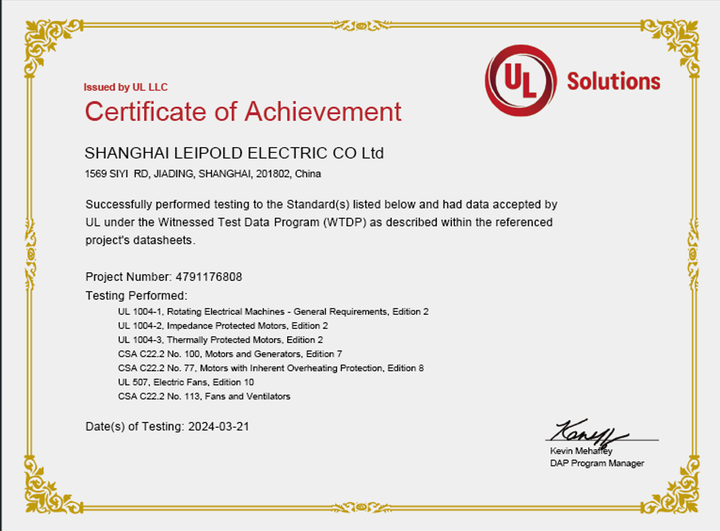
Important Compliance Notice: Certification coverage is product- and model-specific. Not every product variant carries every certification mark. Compliance must always be confirmed against the specific part number, official certificate, or formal Declaration of Conformity.
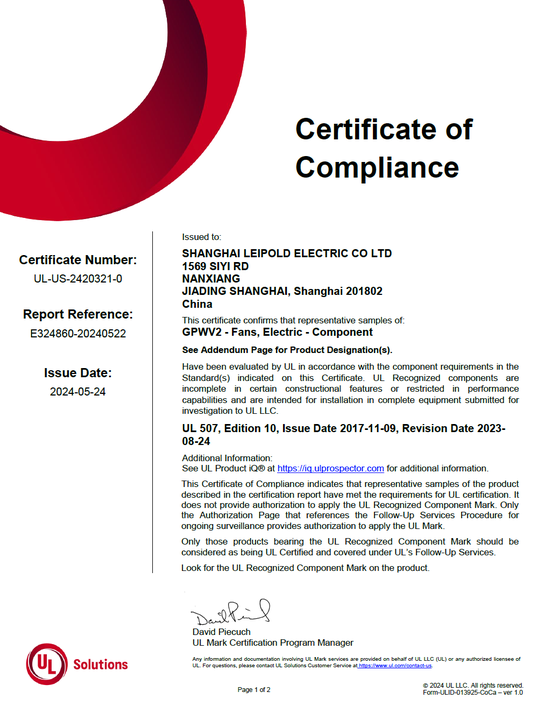
LEIPOLE Product Compliance Landscape
● Enclosure Air Conditioners: CE verified via Declaration of Conformity (EU LVD 2014/35/EU, EN IEC 60335-2-40:2023+A11:2023 and related EN 60335-1 amendments); RoHS material compliance declared. UL/cUL recognition applies to select series only — confirm coverage against the exact model number before citing UL status.
● Power Distribution Blocks, Busbar Systems & Wiring Ducts: CE verified (EU LVD 2014/35/EU, EN 50085-1:2005+A1:2013); UL Recognized Component verified (UL 1565 Positioning Devices, active status); RoHS material compliance declared. Coverage applies to the certified cable duct / wiring duct series — confirm exact model number against the certificate.
● Fan Filters & Fans, Heaters & Controls, Vortex Tubes/Coolers, Thermostats & Hygrostats: Some models in these product lines hold CE, UL Recognized, and/or RoHS certification. Coverage is model-specific and not yet verified for every SKU — please request the certificate matching your exact part number before citing certification status.
Certification Landscape Across LEIPOLE Product Categories
|
Product Category |
Typical Certification Coverage |
Applicable Standards & Scope |
Key Considerations for Engineers |
|
Filter Fans & Exhaust Filters |
Select models hold CE, UL Recognized, and/or RoHS certification; verify against the certificate for the exact model number. |
EN 60335-1, EN 60529 (IP ratings), UL 508A / UL 507, UL 94V-0 (plastics) |
Flame-retardant ABS/polycarbonate housing; verify specific model suffix for UL recognition. |
|
Axial & Centrifugal Fans |
Select models hold CE, UL Recognized, and/or RoHS certification; verify against the certificate for the exact model number. |
EN 60335-2-80, UL 507, Impedance/Thermal Protection Standards |
Evaluated for continuous operation, motor insulation classes, and electrical safety. |
|
Enclosure Air Conditioners |
CE verified (Declaration of Conformity GTSC20240612021-1-01); RoHS material compliance declared. UL/cUL applies to select series only — verify against the exact model number. |
EN IEC 60335-2-40:2023+A11:2023, EN 60335-1 (as amended), UL 484 (Room Air-Conditioners standard; evaluated/adapted for enclosure AC use), EMC Directives |
Covers refrigerant safety, high/low pressure switches, and condensate management systems. |
|
Vortex Coolers (Cabinet Coolers) |
RoHS, Mechanical Conformity |
Pressure equipment guidelines, non-electrical mechanical safety |
Purely pneumatic operation; electrical directives do not apply. Although outside RoHS's formal regulatory scope, LEIPOLE voluntarily provides a material compliance declaration. |
|
Enclosure Heaters (PTC & Fan Heaters) |
Select models hold CE, UL Recognized, and/or RoHS certification; verify against the certificate for the exact model number. |
EN 60335-2-30, UL 499 (Electric Heating Appliances) |
Self-regulating PTC elements; evaluated for surface temperature limits and touch-safe housing. |
|
Thermostats & Hygrostats |
Select models hold CE, UL Recognized, and/or RoHS certification; verify against the certificate for the exact model number. |
EN 60730-1 (Automatic Electrical Controls), UL 873 / UL 60730 |
Switching capacity, contact reliability, and creepage/clearance distances inside the panel. |
|
Power Distribution Blocks, Busbar Systems & Wiring Ducts |
CE verified (UDEM Certificate M.2019.206.C0514); UL Recognized verified (Certificate E516507, UL 1565, Active status); RoHS material compliance declared for the certified series. Other models: verify against the exact model number. |
EN 60947-7-1, UL 1059 (Terminal Blocks), UL 94V-0; EN 50085-1:2005+A1:2013 and UL 1565 Positioning Devices (Wiring/Cable Ducts) |
Short-Circuit Current Ratings (SCCR) and high-voltage dielectric isolation integrity. |
5. Application Scenarios & Engineering Relevance
Compliance requirements vary based on where and how the control panel enclosure is deployed:
● Industrial Automation Control Panels: Automated assembly lines rely on continuous climate control. Filter fans and thermal controls carrying UL recognition simplify the overall panel certification process under UL 508A, preventing costly field-evaluation delays.
● Machine Tool Control Cabinets: Subject to oil mists, metal shavings, and vibration. Components require verified IP ratings (e.g., IP54/IP55 under EN 60529), flame-retardant enclosures (UL 94V-0), and CE/EMC compliance to prevent electrical noise from disturbing sensitive CNC controllers.
● Power Distribution & Switchgear Enclosures: High-amperage environments require verified dielectric properties, creepage clearances, and heat dissipation solutions tested for continuous thermal cycling.
● Outdoor & Harsh Environment Electrical Cabinets: Telecom base stations, solar inverter stations, and wastewater treatment plants demand enclosure air conditioners and heaters verified for wide operating temperature ranges (-40°C to +55°C) and environmental corrosion resistance.
● OEM Export Machinery: Exporting turnkey equipment to Europe or North America requires dual-track documentation. Using components that hold both CE declarations and UL recognition allows OEMs to standardize on a single engineering BOM.
6. How Technical Buyers Can Verify Certification Claims
Never rely solely on a catalog logo. When auditing suppliers for an industrial control panel enclosure project, use this five-step verification framework:
Certification Verification Checklist:
1. Match the exact model number, including voltage, bearing, and IP suffixes.
2. Validate against a third-party database (e.g., the UL Product iQ Directory).
3. Inspect the Declaration of Conformity for applicable directives and harmonized standards.
4. Verify the scope and Conditions of Acceptability (temperature, mounting).
5. Review material compliance documentation, including lab test methods.
Step-by-Step Verification Protocol
1. Verify the Exact Model Number and Suffixes: Suffixes often denote critical technical differences (e.g., voltage variations, bearing types, flame-retardant resin grades, or IP seals). Ensure the certificate explicitly covers the exact part number ordered, not just a base product family.
2. Query Official Third-Party Databases:
○ For UL: Search the UL Product iQ online directory. Search using the manufacturer's UL File Number (e.g., E-file numbers) or Category Control Number (CCN). Verify that the file status is "Active."
○ For CE: Review the manufacturer's signed EU Declaration of Conformity (DoC). The DoC must list the applicable EU Directives, the specific harmonized standards applied (e.g., EN 60335-1:2012+A11), the date of issue, and the signature of an authorized company officer.
3. Check the Applicable Standard Edition: Standards are updated periodically. Ensure the component was tested against currently active standards rather than withdrawn historical editions.
4. Examine the Scope and "Conditions of Acceptability": For UL Recognized components, the UL report defines specific installation conditions (e.g., maximum ambient temperature, required external overcurrent protection, minimum air clearances). If the component is used outside these parameters, the panel's listing may be compromised.
5. Request Granular RoHS Documentation: A generic statement saying "all items are green" is insufficient for strict audits. Request formal material declarations or third-party laboratory test reports (e.g., IEC 62321 test methods for hazardous substances).
7. Beyond Certification: Key Engineering Selection Parameters
While certification establishes regulatory and baseline safety compliance, it does not ensure that a component will perform properly in a specific cabinet. Engineers must evaluate several mechanical, electrical, and thermal parameters alongside certification status:
● Thermal Load & Effective Airflow (ΔT and CFM): Calculating internal heat dissipation (W) versus ambient temperature determines the required airflow (m³/h or CFM) or refrigeration capacity (W or BTU/h). A UL-recognized fan that is undersized will still lead to cabinet overheating and component trips.
● Voltage, Frequency, and Tolerances: Verify whether cooling units and fans operate on 50Hz, 60Hz, or dual 50/60Hz. Running a 50Hz-rated fan at 60Hz increases rotational speed, power draw, and heat output, potentially overloading the motor.
● Ingress Protection (IP / NEMA Type): An enclosure fan filter must match or exceed the protection rating of the cabinet (e.g., IP54, IP55, NEMA Type 12, Type 4). The gasket material, filter media density, and louver geometry directly impact water and dust exclusion.
● Mechanical Footprint and Cutout Dimensions: Panel space is a constraint. Check internal clearance depths, cutout dimensions, and mounting mechanisms (tool-less snap-in vs. screw fastening).
● Operating Ambient Conditions: High humidity, conductive dust, coastal salt spray, or corrosive atmospheres require specialized filter media, conformal coating on fan electronics, or closed-loop enclosure air conditioners.
8. Essential Documentation Package for OEM Procurement
To ensure smooth incoming inspections, quality audits, and compliance reviews, technical buyers should request a standard documentation package from their enclosure component supplier:
|
Document Type |
Primary Purpose |
Key Information Contained |
|
Declaration of Conformity (DoC) |
Legal verification for CE compliance |
List of EU directives, harmonized EN/IEC standards, manufacturer details, authorized signature |
|
UL Certificate of Compliance (CoC) |
Proof of UL Listing or Component Recognition |
UL File Number, CCN, covered model series, reference testing standards |
|
RoHS Declaration of Conformity |
Material safety and chemical compliance |
Confirmation of compliance with Directive 2011/65/EU and (EU) 2015/863, substance threshold affirmations |
|
Technical Datasheet & Dimensional Drawings |
Engineering and mechanical integration |
Rated voltage, power consumption, static pressure curves, IP ratings, cutout templates, CAD/STEP models |
|
Material / Flammability Reports |
Fire safety compliance |
Plastic resin flammability ratings (UL 94V-0, V-1, HB), glow-wire test results |
|
ISO 9001 Quality Certificate |
Manufacturing quality management |
Proof of consistent production control, quality assurance, and traceability systems |
Frequently Asked Questions (FAQ)
Is a CE-marked component automatically accepted in the United States?
No. CE marking is an administrative requirement for the European Economic Area based largely on manufacturer self-declarations. In the United States, electrical safety compliance is governed by the National Electrical Code (NEC) and OSHA regulations, which typically require third-party certification marks such as UL Listed or UL Recognized (or other accredited Nationally Recognized Testing Laboratories - NRTLs).
What is the difference between a UL Listed device and a UL Recognized component?
A UL Listed device is a complete, standalone product tested for direct installation in the field. A UL Recognized Component (RU mark) is an incomplete part or subsystem (such as a cabinet filter fan, thermostat, or terminal block) designed to be factory-installed within a larger system, like an industrial control panel enclosure. UL Recognized components are subject to specific "Conditions of Acceptability" during panel evaluation under UL 508A.
Does RoHS compliance mean a product meets electrical safety standards?
No. RoHS is strictly an environmental regulation restricting specific hazardous chemicals (such as lead, mercury, and phthalates) in homogeneous materials. It does not test or verify electrical insulation, thermal endurance, fire resistance, or structural integrity.
Can I build a UL 508A panel using non-UL components?
Using unlisted or uncertified components in a UL 508A panel often requires extensive, costly field testing by an inspector or may prevent the panel from receiving its UL listing mark. Using pre-certified UL Recognized components streamlines panel evaluation and helps ensure immediate acceptance by Authorities Having Jurisdiction (AHJs).
Does every product from an industrial supplier carry CE, UL, and RoHS markings?
Not necessarily. Certification coverage is model-specific and depends on the intended market and product configuration. For example, standard AC axial fans may hold both CE and UL recognition, whereas specialized custom-voltage models or mechanical accessories might hold CE and RoHS compliance only. Always request the specific certificate corresponding to your exact part number.
Technical Support & Compliance Verification with LEIPOLE
Selecting the right climate control and electrical distribution accessories requires balancing thermal engineering with strict regulatory compliance. LEIPOLE provides a comprehensive range of industrial enclosure solutions—including filter fans, high-efficiency enclosure air conditioners, PTC heaters, thermostats, and connection systems—tailored to international OEM specifications.
For specific model certifications, technical datasheets, 3D CAD files, or formal Declarations of Conformity:
● Contact the LEIPOLE Technical Engineering Team to review your panel requirements.
● Request official UL File Numbers, CE DoC files, and RoHS 3 material declarations for your project's BOM.
● Access customized thermal calculation support to ensure your enclosure cooling solution meets both performance and compliance standards.