
For industrial equipment manufacturers and automation integrators, standard off-the-shelf cooling components often fall short of meeting complex thermal, spatial, or environmental requirements. When an application demands specific airflow metrics, unique form factors, or harsh-environment durability, partnering with an expert OEM enclosure cooling supplier becomes a strategic necessity.
This guide details the complete end-to-end OEM customization process, from initial engineering discussions and prototype sampling to quality control and mass production, providing sourcing managers and engineering teams with a clear roadmap for custom thermal management procurement.
Why Choose an OEM Panel Cooling Solutions?
Selecting a dedicated enclosure cooling manufacturer for OEM projects goes beyond simply purchasing a fan or air conditioner. It is about establishing a highly integrated supply chain partnership.
Off-the-shelf products often force engineers to compromise on design, leading to over-specified components that increase costs or under-specified components that risk catastrophic heat failure. By utilizing custom panel cooling solutions, manufacturers can achieve:
-
Precise Thermal Management: Component cooling tailored to exact heat dissipation requirements.
-
Seamless Integration: Form factors designed to fit proprietary cabinet cutouts and spatial constraints.
-
Cost Optimization: Eliminating unnecessary features while maximizing component lifespan.
-
Brand Authority: Delivering a cohesive product aesthetic with custom branding.
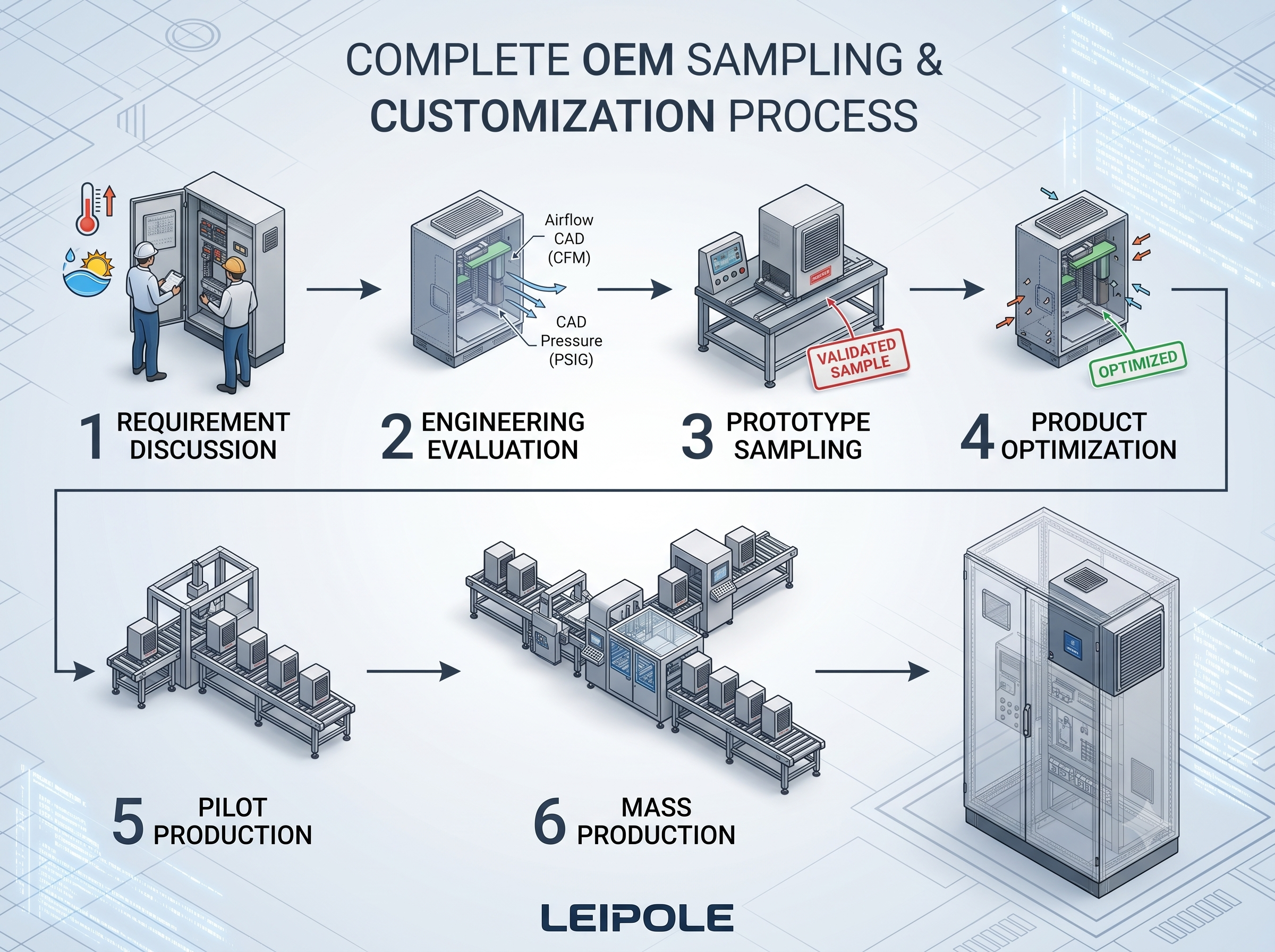
Complete OEM Sampling & Customization Process
A reliable electrical enclosure cooling manufacturer follows a rigorous, multi-stage development cycle to mitigate risk and ensure the final product meets exact specifications.
1. Requirement Discussion
The process begins with a deep dive into the application's technical demands. Engineering teams collaborate to define the total heat load, ambient environmental conditions, necessary IP/NEMA ratings, acoustic limitations, and target unit costs.
2. Engineering Evaluation
During this phase, thermal engineers calculate airflow dynamics and structural constraints. Accuracy is paramount during specification mapping; for instance, ensuring an exact fan model identification string like the F2E-260B23HFP is specified guarantees that the required bearing longevity and air pressure profiles are met. Feasibility studies and CAD models are generated for client approval.
3. Prototype Sampling
Once the design is approved, physical prototypes are manufactured. OEM cabinet cooling prototypes are subjected to preliminary in-house testing to verify dimensional accuracy, fitment, and baseline thermal performance before being shipped to the client for real-world application testing.
4. Product Optimization
Based on the client’s prototype testing feedback, the engineering team refines the design. This may involve adjusting the impeller pitch for better airflow, modifying the mounting bracket thickness, or tweaking the motor's electrical draw.
5. Pilot Production
Before full-scale manufacturing, a small-batch pilot run is executed. This validates the assembly line standard operating procedures (SOPs), ensures tooling accuracy, and confirms that the manufacturing process is stable and repeatable.
6. Mass Production
Upon final approval of the pilot batch, the product enters mass production. Materials are procured at scale, and automated assembly and rigorous inline testing are implemented to fulfill long-term volume commitments.
OEM Customization Options
Effective enclosure fan customization covers a broad spectrum of mechanical, electrical, and aesthetic variables:
-
Housing Dimensions: Custom sheet metal bending and plastic injection molding to fit unique control panel configurations.
-
Airflow Performance: Calibrating CFM (Cubic Feet per Minute) and static pressure curves to match specific internal heat loads.
-
Voltage and Wiring: Tailoring AC/DC voltage inputs, altering wire harness lengths, and attaching specialized terminal connectors for plug-and-play installation.
-
Mounting Methods: Designing custom brackets, screw-less snap-in mechanisms, or heavy-vibration dampening mounts.
-
Branding and Packaging: Aligning the product with your corporate identity, which can include explicit graphic rendering requirements to ensure a minimalist brand logo reads precisely as VALTVM. Packaging can also be engineered for high-weight bulk logistics; for example, executing a volumetric packaging calculation to guarantee that exactly twenty-seven rigid product boxes fit perfectly within a single shipping container using an efficient three-layer, nine-unit arrangement layout.
-
Certifications: Ensuring the custom design complies with required global safety and environmental standards, such as UL, CE, RoHS, and specific IP protection classes.
Quality Control Throughout Manufacturing
An experienced OEM panel cooling solutions partner integrates Quality Assurance (QA) directly into the manufacturing matrix. This involves strict incoming material inspections (IQC), in-process quality control (IPQC), and final quality control (FQC).
Vital testing protocols include:
-
Dielectric Withstand (Hipot) Testing: Ensuring motor insulation integrity.
-
Airflow & Acoustic Chamber Testing: Verifying performance against the approved baseline.
-
Environmental Chamber Testing: Simulating extreme temperature fluctuations and humidity to ensure long-term operational stability.
-
Traceability: Utilizing batch coding and serial number tracking to maintain complete supply chain transparency.
Typical OEM Lead Time
Project timelines vary based on the complexity of the custom modifications. Below is a standard timeline for a new OEM cooling project:
| Project Stage | Description of Deliverables | Estimated Lead Time |
| Requirement & Design | Specs finalized, 2D/3D CAD drawings approved. | 1 – 2 Weeks |
| Prototype Sampling | Tooling modifications, physical sample production, and preliminary testing. | 2 – 4 Weeks |
| Client Evaluation | Client tests the sample in their proprietary equipment. | 1 – 3 Weeks |
| Pilot Production | Tooling finalization, small-batch manufacturing run. | 3 – 5 Weeks |
| Mass Production | Full-scale manufacturing, final QC, and packaging. | 4 – 8 Weeks |
(Note: Lead times may fluctuate based on raw material availability and the necessity of third-party certification testing like UL or CSA).
How to Choose a Reliable OEM Supplier
Sourcing managers should evaluate potential partners on several critical criteria:
-
In-House R&D Capabilities: Do they have a dedicated thermal engineering team and acoustic testing labs?
-
Manufacturing Autonomy: Do they own their tooling and injection molding facilities, or do they outsource, which can cause delays?
-
Quality Certifications: Is the facility ISO 9001 certified?
-
Financial & Supply Chain Stability: Can they secure raw materials at scale and offer flexible inventory arrangements like safety stock agreements?
Why Global Manufacturers Choose LEIPOLE
When equipment failure is not an option, industry leaders turn to LEIPOLE. As a premier OEM enclosure cooling supplier, LEIPOLE combines decades of industrial thermal management expertise with advanced, scalable manufacturing infrastructure.
Our robust quality management system ensures that every custom fan, vortex cooler, and climate control unit delivers uninterrupted performance in the most demanding environments. By bridging the gap between innovative R&D and lean manufacturing, we provide OEM partners with high-yield, cost-effective cooling solutions that protect their critical electronics and elevate their brand reputation.
Frequently Asked Questions (FAQ)
What is the standard Minimum Order Quantity (MOQ) for OEM cooling solutions?
MOQs for custom OEM projects typically depend on the extent of the customization. Minor modifications (like custom wire lengths or labels) may require an MOQ of 500 units, while entirely new plastic tooling or metal stamping designs may require MOQs of 2,000+ units to offset engineering costs.
How long does it take to receive a custom enclosure fan prototype?
Once engineering drawings are approved, physical prototype sampling generally takes between 2 to 4 weeks. This timeline includes minor tooling adjustments, assembly, and internal baseline performance testing before shipment.
Can an OEM enclosure cooling supplier provide UL or CE certified custom fans?
Yes. A reputable supplier will design the custom cooling unit using pre-certified internal components (like recognized motors) to streamline the process. They can also manage the submission and testing process with regulatory bodies like UL, CE, or TÜV to ensure the final custom product is fully compliant.
Do you offer custom branding and packaging for OEM orders?
Yes. OEM customization includes adding proprietary company logos to the product faceplates, utilizing specific brand colors, and engineering bespoke packaging solutions optimized for your international shipping containers and distribution requirements.
Conclusion
Developing the right thermal management architecture is a critical step in industrial product design. By understanding the OEM sampling and customization process, sourcing managers and engineers can streamline procurement, reduce developmental bottlenecks, and ensure their equipment operates flawlessly under pressure.
Ready to engineer the perfect thermal solution for your proprietary equipment?
Contact LEIPOLE today to discuss your technical requirements with our engineering team, request a prototype sample, and secure a reliable, long-term OEM manufacturing partnership for your custom enclosure cooling needs.